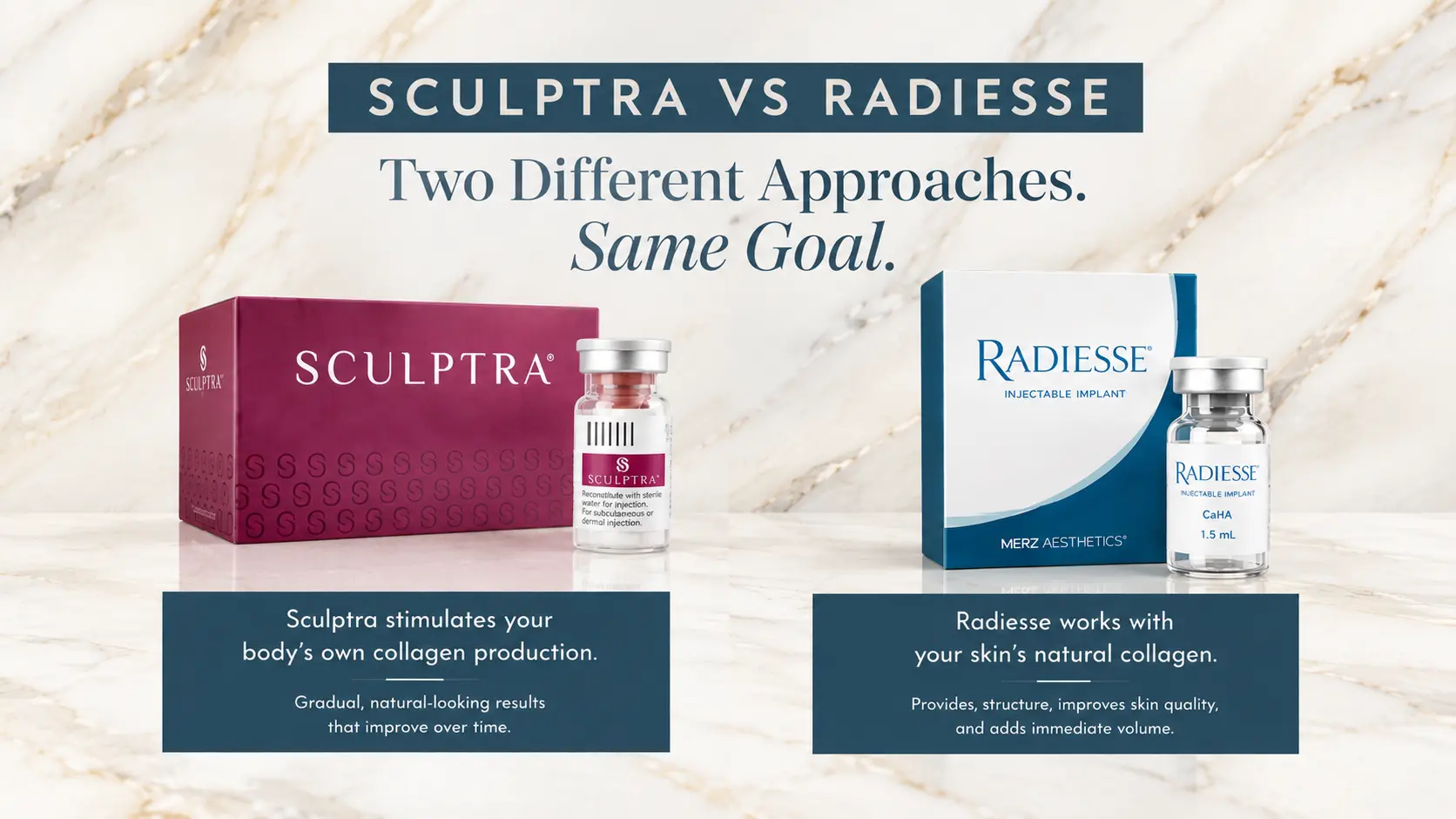
Patients researching a liquid facelift tend to circle back to the same pair of names. Sculptra and Radiesse both rebuild the structure a face loses with age, and a glossy brochure makes them sound almost interchangeable. They run on very different clocks, and each one was built for a different kind of face.
The decision gets simpler once you separate what each product does inside the skin. One replaces volume the moment the needle comes out. The other asks you to wait while your own collagen does the work.
If you are weighing Sculptra in Lexington, Louisville, and London, KY against Radiesse injections in Kentucky, this walks through how the two differ on mechanism, results, longevity, and the kind of aging each one corrects best.
What is Sculptra?
Sculptra is injectable poly-L-lactic acid, a biostimulator that prompts your own skin to lay down fresh collagen. The poly-L-lactic acid arrives as microparticles suspended in sterile fluid. Within a day or two that fluid disperses and the early plumping from it fades, which catches new patients off guard. What stays behind is a fine lattice of particles your body reads as something to remodel around.
Over the following weeks, cells called fibroblasts respond to that lattice by producing type I collagen, the structural protein that gives young skin its firmness. The volume you eventually see is your own tissue rather than the product. That is the entire premise of a biostimulator, and it explains why Sculptra rewards patience instead of delivering an instant change.
The molecule has a long track record. The FDA cleared Sculptra in 2004 for facial fat loss in patients with HIV, then expanded the approval in 2009 to cosmetic use for smile lines and other facial wrinkles. The years of use since have made it one of the better understood collagen stimulators in aesthetic medicine.
What is Radiesse?
Radiesse is calcium hydroxylapatite suspended in a smooth gel, a filler that corrects volume the same day and then stimulates collagen as it breaks down. The product is roughly 30 percent calcium hydroxylapatite microspheres carried in about 70 percent carboxymethylcellulose gel.
Those two ingredients do two separate jobs. The gel carrier fills and lifts the moment it is placed, so you leave the appointment already looking corrected. Over the next several weeks the gel is absorbed while the microspheres stay behind, acting as a scaffold that fibroblasts attach to and build collagen around. The particles themselves eventually break down into calcium and phosphate that the body clears on its own.
Radiesse earned FDA approval in 2006 for moderate to severe facial folds and for facial fat loss related to HIV. In 2015 it became one of the few fillers cleared to restore volume on the back of the hands.
How is a collagen stimulator different from a regular filler?
Most people picture filler as a gel that sits where it is placed and holds a shape, which describes hyaluronic acid products well. Sculptra and Radiesse belong to a different category. Instead of acting purely as a spacer under the skin, they prompt the body to generate its own collagen, so a real share of the final result is tissue you grew rather than material you were injected with.
That distinction explains almost everything else about them. It is why the results look natural as they mature, why they tend to outlast a typical gel, and why they cannot be dissolved in an afternoon the way hyaluronic acid can. Radiesse straddles both worlds, giving instant gel volume plus collagen over time, while Sculptra commits fully to the collagen route with no lasting filler volume of its own.
How do the two compare side by side?
Sculptra | Radiesse | |
|---|---|---|
Active material | Poly-L-lactic acid (PLLA) | Calcium hydroxylapatite (CaHA) |
Category | Pure biostimulator | Filler plus biostimulator |
Immediate volume | None, the carrier fluid fades within days | Yes, visible the same day |
How results appear | Gradually, over weeks as collagen builds | Instantly, then improves as collagen builds |
Typical course | Around three sessions, spaced weeks apart | Often one session, with an optional touch-up |
Longevity | Up to two years | Roughly twelve to fifteen months |
Best suited for | Broad, all-over volume loss | Deeper folds, structural lift, and hands |
Can it be dissolved? | No, it resolves as it breaks down | No, it resolves as it breaks down |
Not used for | Lips and fine etched lines | Lips |
| Feature | Sculptra | Radiesse |
|---|---|---|
| Active material | Poly-L-lactic acid (PLLA) | Calcium hydroxylapatite (CaHA) |
| Category | Pure biostimulator | Filler plus biostimulator |
| Immediate volume | None, the carrier fluid fades within days | Yes, visible the same day |
| How results appear | Gradually, over weeks as collagen builds | Instantly, then improves as collagen builds |
| Typical course | Around three sessions, spaced weeks apart | Often one session, with an optional touch-up |
| Longevity | Up to two years | Roughly twelve to fifteen months |
| Best suited for | Broad, all-over volume loss | Deeper folds, structural lift, and hands |
| Can it be dissolved? | No, it resolves as it breaks down | No, it resolves as it breaks down |
| Not used for | Lips and fine etched lines | Lips |
What the research shows A narrative review published in the Aesthetic Surgery Journal describes calcium hydroxylapatite as a regenerative agent that drives new type I and type III collagen, fresh elastin, and new blood vessels, and notes it does so with far less immune activity than poly-L-lactic acid (source). Both products build collagen. They simply recruit the body along different routes to get there. |
Which face points toward Sculptra?
Sculptra suits the face that has thinned everywhere rather than sagged in one spot. Temples that have hollowed and cheeks that have flattened respond well to a product that restores volume broadly and quietly. Because the collagen builds over time, the change reads as looking rested rather than looking done, which is what many patients in their forties and fifties are after.
Treatment usually runs as a short series. Most patients receive around three sessions spaced several weeks apart, with the full result settling in over two to three months as collagen accumulates. Our guide to Sculptra for lower face rejuvenation covers how that plays out along the jaw and lower cheeks, where lost scaffolding shows up as early jowling. What Sculptra does not handle is sharp, precise correction. Etched lip lines and fine detail belong to other products.
Which face points toward Radiesse?
Radiesse suits the face that needs structure and wants it now. Deep folds beside the mouth and a jawline that has lost its edge respond to the firmness of calcium hydroxylapatite, which gives it real lifting power. Patients who cannot spare two months for a gradual reveal often choose it for that reason, since the correction is visible as soon as they sit up.
Diluted more heavily, Radiesse takes on a second role. Spread thin across the neck or decolletage, it behaves less like a filler and more like a collagen treatment, improving skin quality over an area too broad for structural filling. Most patients see results hold for roughly twelve to fifteen months, and the collagen left behind can extend the benefit past the point where the product itself is gone.
How soon will you see a change, and how long does it last?
This is where the two diverge most. Radiesse shows up immediately, then quietly improves as collagen forms around the microspheres. Sculptra shows nothing dramatic at first and reveals itself over two to three months, which is a feature rather than a flaw for anyone who wants the change to go unnoticed as it happens.
Longevity follows a similar split. Sculptra tends to hold up to two years, while Radiesse commonly runs twelve to fifteen months before a refresh. Neither number is a hard stop, because both leave real collagen behind, and that collagen can keep contributing after the material itself has gone.
The one-line version Want an immediate, structural result in a single visit? Radiesse usually wins. Want a gradual, all-over restoration and you are willing to wait for it? Sculptra usually fits better. Some faces call for both, used in different zones. |
Can either filler be dissolved if you dislike it?
Neither product can be dissolved on demand. Hyaluronic acid fillers such as Belotero or Kysse can be reversed within a day using an enzyme called hyaluronidase, which is part of why they remain the standard for lips and other high-stakes areas. Sculptra and Radiesse have no such off switch. A poor result softens as the material breaks down over months rather than being erased in an afternoon.
That raises the stakes on who holds the syringe. Placement, depth, and dilution decide the outcome, and there is no quick correction if any of them is off. It is the strongest argument for treating a biostimulator as a medical procedure rather than a walk-in purchase.
What actually shapes your result?
Two things carry most of the weight:
- The hands doing the injecting. Product choice matters less than where and how deeply it is placed, and both stimulators are unforgiving of rushed technique.
- What you bring to it. Sun protection and a steady skincare routine protect the collagen you are paying to build, and realistic patience keeps you from judging Sculptra before it has finished.
Who should think twice about a biostimulator?
Active infection or inflammation at the treatment site rules out injection until it clears. A history of keloids or a tendency to form nodules calls for a careful conversation, as does any autoimmune condition that affects healing. Pregnancy and breastfeeding are standard reasons to wait. A thorough consultation catches these before anything is injected, which is one more reason to start with an evaluation rather than a booking button.
What does treatment actually involve?
Both treatments are quick office visits. After mapping the areas that have lost support, your provider injects the product through fine needles or a blunt-tipped cannula, working in the deeper planes where these materials belong. A typical session runs under an hour, and most patients return to normal activities the same day, with the usual chance of minor swelling or bruising that settles within a few days.
Sculptra carries one extra instruction. Because the particles need to distribute evenly, patients are often asked to massage the treated areas at home for a few days after each session, following the schedule their provider hands them. Radiesse needs no such homework, since its result is set at the time of injection. Neither treatment forces you to plan around real downtime, though booking a couple of weeks before a major event is still wise in case of bruising.
How does your provider choose between them?
At Ageless Center the choice starts with your goal rather than the product menu. If you want an immediate structural change in one visit, Radiesse tends to win. If you want a gradual, all-over restoration and can wait for it, Sculptra usually fits better. Faces that need both get a plan that places each product where it does the most good.
Collagen stimulators are also only one part of what our dermal filler treatments in Kentucky can do, and volume is only one part of aging. When the real concern is skin texture and crepiness rather than lost support, a resurfacing option such as Morpheus8 in Kentucky or a consistent medical-grade skincare routine may do more than any filler. Your provider will tell you plainly when that is the case.
Frequently asked questions
Is Sculptra or Radiesse better for cheeks?
Both work in the cheeks, and the better choice depends on what you want. Sculptra restores cheek volume gradually and all over, while Radiesse gives an immediate lift with more structure. Patients who want a visible result the same day lean Radiesse. Patients who want a slow, natural rebuild lean Sculptra.
Does Radiesse hurt more than Sculptra?
Both are injections, and both are made more comfortable with numbing and careful technique. Radiesse can be mixed with lidocaine to ease the sensation during placement. Most patients describe either treatment as brief discomfort rather than real pain.
Can Sculptra and Radiesse be used together?
Yes. Providers often use them in different zones or at separate visits, letting Radiesse handle structural areas while Sculptra restores broader volume. Your provider maps out which product goes where based on your face.
Which one lasts longer?
Sculptra typically holds up to two years, and Radiesse commonly runs twelve to fifteen months. Because both leave collagen behind, some benefit can persist past those windows, though a refresh is usually planned before results fully fade.
Will anyone be able to tell right away?
With Radiesse, yes, since the volume is visible the same day. With Sculptra, no, because the change appears so gradually that it tends to read as looking well rested rather than treated.
Can either one replace a facelift?
No. Both restore volume and stimulate collagen, but neither removes significant skin laxity. Sagging skin that no longer responds to volume is a surgical question, and a good provider will say so rather than overselling an injectable.
Ready to find out which one fits your face?
The right answer starts with your goal, not the product. At Ageless Center, a medical provider assesses your facial structure and skin quality, explains what each stimulator would realistically do for you, and tells you honestly when a different treatment would serve you better.
We see patients at our Lexington, Louisville, and London, KY locations.
Schedule your consultation to build a plan around the result you actually want.