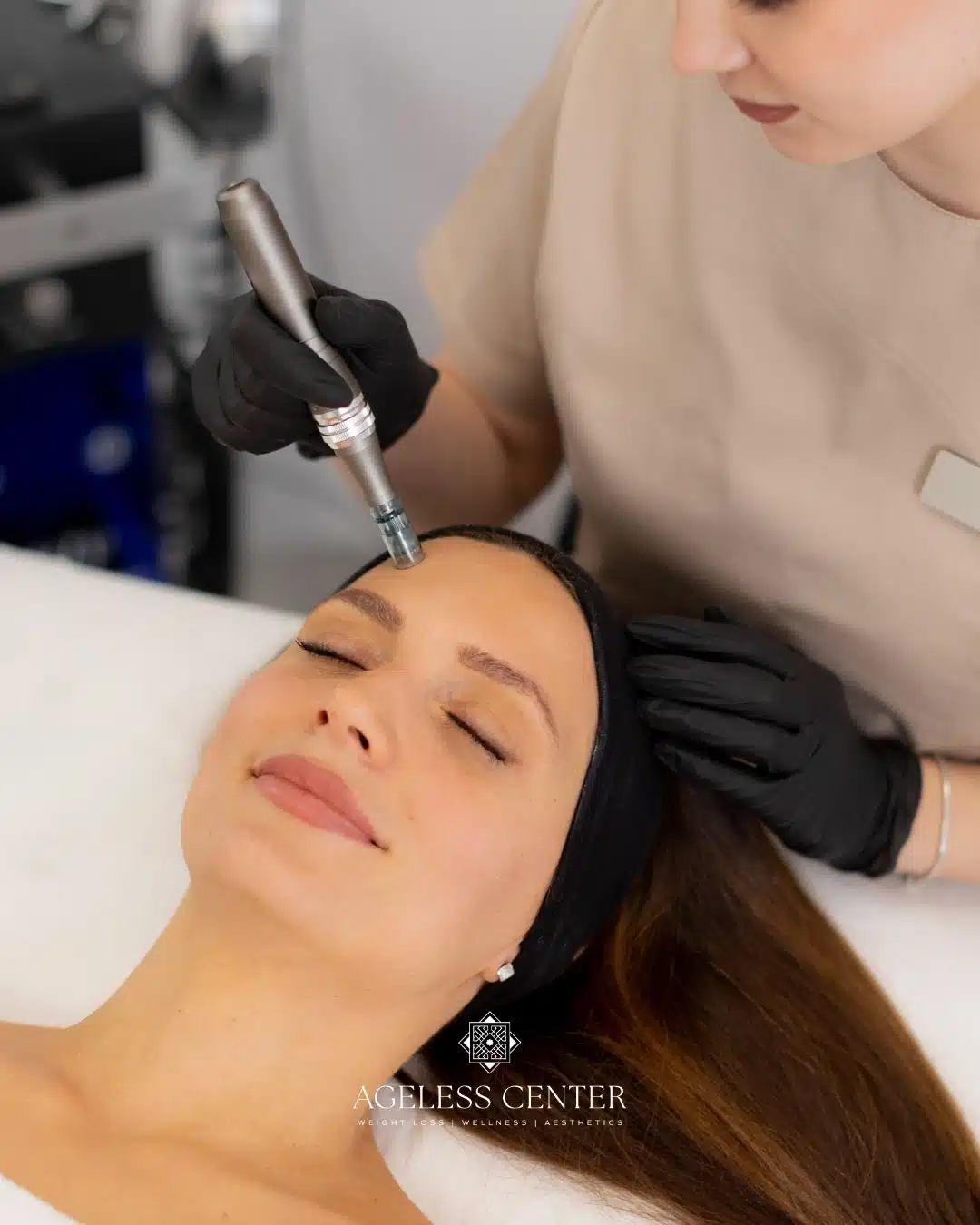
Morpheus8 is a fractional radiofrequency microneedling device used to remodel collagen in the deeper layers of facial skin. The treatment delivers controlled thermal energy through a grid of fine microneedles into the dermis, where it triggers a wound-healing response that produces new collagen and elastin over the weeks and months that follow. The visible outcome is firmer, more refined skin with improved tone across the jawline and around the eyes.
The device has become one of the most commonly requested non-surgical options for patients who want meaningful improvement in facial laxity, fine lines, acne scarring, and uneven texture without committing to a facelift or extended recovery. At Ageless Center, Morpheus8 facial treatments in Lexington, Louisville, and London, KY form part of a broader approach to facial rejuvenation that pairs in-clinic procedures with longer-term skin health strategies.
How Morpheus8 works on facial skin
Morpheus8 brings together two technologies in a single handpiece. A grid of coated microneedles penetrates the skin at adjustable depths, typically between 1 and 4 millimeters for facial applications. Once the needles reach the target depth, bipolar radiofrequency energy travels through the tips into the surrounding tissue. The RF heats the dermal layer in a controlled, fractionated pattern.
That thermal effect produces two outcomes. The first is immediate contraction of existing collagen fibers, which creates a subtle tightening visible within days of treatment. The second is a sustained wound-healing cascade that generates new collagen and elastin over the weeks that follow. Together these mechanisms reshape the underlying scaffolding of facial skin in a way that topical products cannot replicate.
A 2024 histological study published in the Journal of Cosmetic Dermatology documented measurable structural changes in skin treated with a single Morpheus8 session, including new elastin formation in the reticular dermis, increased vascularity, and compaction of both the papillary and reticular dermal layers (source). The researchers attributed these changes to the radiofrequency component rather than the mechanical microneedling alone.
For the face, the adjustable needle depth matters because different zones require different settings. The thicker skin of the cheek and jawline benefits from deeper energy delivery, while the more delicate skin around the eyes and forehead is treated with shallower passes at lower energy levels. That adaptability is part of what makes the device suitable for full-face rejuvenation rather than a single region.

What Morpheus8 addresses on the face
Facial skin loses its structural integrity gradually. Collagen production declines by roughly 1 percent per year after the mid-twenties, and the cumulative effect becomes visible in the form of softened jawlines, deeper nasolabial folds, fine lines, and surface irregularities. Sun exposure, hormonal changes, and genetic predisposition accelerate the process for many patients.
The treatment can improve:
- Mild to moderate skin laxity along the jawline, jowls, and submental area
- Acne scarring, particularly the rolling and boxcar varieties
- Enlarged pores and uneven texture across the cheeks and forehead
- Fine lines around the eyes and mouth
- Overall facial firmness and tone
Because the energy is delivered below the surface where the wound-healing response takes place, the improvements develop progressively. Patients tend to notice cumulative refinement rather than an abrupt change in their appearance.
What a facial treatment session looks like
A Morpheus8 facial session begins with the application of topical numbing cream to the entire treatment area, typically 30 to 45 minutes before the procedure. Once the skin is adequately numbed, the provider passes the handpiece across the face in a systematic grid pattern. The device stamps into the skin at each point, delivers RF energy for a fraction of a second, then lifts and repositions for the next pass.
Most patients describe the sensation as a warm pressure with occasional pinching. The numbing cream makes the treatment well tolerated for the majority of patients, though certain zones near the bone, including the forehead and along the jawline, can feel more intense than fleshier areas like the cheeks.
A full-face treatment usually takes 30 to 45 minutes of active treatment time. Your provider will adjust needle depth and energy level based on the thickness of your skin and the specific zones being targeted, along with the degree of laxity present. The lower face, where structural laxity tends to concentrate, may receive different settings than the more delicate periorbital area.
Recovery and what to expect afterward
Downtime after a facial Morpheus8 session is short compared with surgical alternatives. The face will appear red and mildly swollen for the first 24 to 72 hours, with warmth in the treated area. Small grid-like marks from the microneedles are visible initially and fade within a few days. Some patients develop minor pinpoint bleeding immediately after treatment, which resolves quickly.
Most patients return to work and social activities within two to three days, though some plan their treatment around a weekend for added recovery time. Mineral makeup can typically be applied 48 hours after the procedure. Strenuous exercise and direct sun exposure should be avoided for approximately five to seven days, and saunas should be skipped during the same window.
Recovery timeline at a glance Days 1 to 3: Redness, warmth, and mild swelling. Grid-like marks visible on the skin. Avoid heat, sweat, and direct sun. Days 4 to 7: Swelling subsides. Marks fade. Skin may feel slightly tight or appear dry as the renewal process begins. Gentle moisturizer and SPF are essential. Weeks 2 to 4: Skin begins to feel firmer. Early collagen remodeling is underway, but visible changes are subtle. Months 2 to 3: Progressive tightening and texture refinement become apparent. Patients often notice improvements in tone and jawline definition. Months 3 to 6: Full collagen maturation. Results continue to improve as new collagen and elastin fibers strengthen and organize. |
How many sessions are typically needed
Most patients see their best facial results from a series of two to four sessions spaced four to six weeks apart. The exact number depends on the degree of laxity, the concerns being addressed, and how your skin responds to thermal stimulus.
Patients with mild texture concerns or early laxity may achieve satisfying results in two sessions. Those addressing acne scarring or more pronounced laxity along the jawline typically need three to four sessions to reach their optimal outcome. Each session builds on the collagen remodeling initiated by the previous one, which is why the spacing between treatments matters.
After completing the initial series, many patients schedule maintenance treatments once per year to preserve their results as collagen continues to decline with age.
Who gets the best results
Morpheus8 performs best on patients with mild to moderate facial laxity and skin that still retains some elastic capacity. The ideal candidate has visible changes in firmness or texture but does not yet need surgical intervention to address them.
Patients in their 30s through 50s tend to respond particularly well because their collagen production capacity, while slowed by age, can still be activated effectively by the thermal stimulus. Older patients can also see meaningful improvement, though results may be more gradual and may require additional sessions to reach a satisfying outcome.
Good candidates: Patients with mild to moderate facial laxity, acne scarring, enlarged pores, or early signs of aging who want measurable improvement without surgery or significant downtime. Less ideal for: Patients with severe skin redundancy that requires surgical lifting, those with active skin infections in the treatment area, or anyone expecting facelift-level results from a non-invasive treatment. |
How Morpheus8 compares to other facial rejuvenation options
Several treatment categories target the visible signs of facial aging, and each one works through a different mechanism. The table below summarizes how Morpheus8 sits alongside the most common alternatives.
Morpheus8 | Surgical facelift | Ablative laser resurfacing | |
|---|---|---|---|
Mechanism | RF microneedling that remodels collagen in the dermis | Surgical repositioning and excision of facial tissue | Removes surface skin layers with heat to stimulate new growth |
Depth of treatment | Up to 4 mm on the face | Full surgical access | Superficial to mid-dermal |
Downtime | 2 to 3 days for most patients | 2 to 4 weeks with activity restrictions | 7 to 14 days of peeling and redness |
Results timeline | Gradual improvement over 3 to 6 months | Immediate structural change | Visible after initial healing |
Best for | Mild to moderate laxity, acne scarring, texture concerns | Severe laxity or significant facial sagging | Surface texture, fine lines, pigmentation |
Anesthesia | Topical numbing | General anesthesia | Topical or sedation |
Combining Morpheus8 with other facial treatments
Facial rejuvenation often works best when several modalities address different layers of the aging process. At Ageless Center, patients pursuing comprehensive results frequently combine Morpheus8 with complementary services depending on what they are trying to resolve.
Many patients pair their Morpheus8 sessions with laser and energy-based skin rejuvenation in Kentucky, which can address pigmentation and vascular concerns at the surface while Morpheus8 works on the structural layer underneath. The two approaches act on different aspects of facial aging and complement each other when sequenced thoughtfully.
Patients who are also focused on the hormonal drivers of skin aging often see enhanced results when their Morpheus8 plan is paired with hormone replacement therapy for women in Kentucky or men’s hormone therapy in Lexington and Louisville. Estrogen and testosterone both play direct roles in skin repair, collagen synthesis, and dermal thickness, which is why hormonally optimized patients sometimes experience stronger collagen responses to RF microneedling.
For patients interested in an integrated approach to aging, the Ageless Center integrative health program can help identify underlying contributors to skin quality, such as nutrient status and thyroid function, which influence how the skin heals and remodels after treatment.
Setting realistic expectations
Patient satisfaction with Morpheus8 correlates closely with the expectations set during the initial consultation. The device produces firming and refinement of facial skin texture, with measurable improvement in laxity over a period of months. For patients with significant skin redundancy, a surgical facelift remains the standard for repositioning and removing excess tissue. Morpheus8 can complement that surgery either as a preparatory treatment or as a follow-up to address residual texture concerns after healing.
Results develop progressively. Patients who expect a dramatic next-day change tend to be disappointed, while patients who appreciate a gradual, natural-looking improvement over several months tend to be highly satisfied. The improvement is built into the skin rather than layered on top of it, which is part of why the outcome looks authentic rather than artificially altered.
Frequently asked questions
How much does Morpheus8 for the face hurt?
With proper topical numbing applied for 30 to 45 minutes before treatment, most patients describe the sensation as tolerable. There is a warm pressure and occasional pinching, particularly along bony areas such as the forehead and jawline. The numbing cream makes the treatment manageable for the vast majority of patients.
When can I wear makeup after a Morpheus8 facial treatment?
Most patients can apply mineral or gentle makeup 48 hours after treatment, once the small grid-like marks have closed. Your provider will give you specific aftercare instructions based on your skin’s response and the settings used during your session.
Will the results look natural?
Yes. Because changes develop gradually over months as new collagen matures, the improvement looks proportional to your existing features. There are no scars and no signs of intervention. Your skin simply looks firmer with smoother texture.
Is there an age limit for facial treatment?
There is no strict age limit. Collagen production capacity does decline with age, so patients in their 60s and 70s may see more modest results compared with younger patients. A consultation will help determine whether Morpheus8 is likely to produce meaningful improvement for your specific skin quality.
Can Morpheus8 be used on the neck?
Yes. The neck is one of the most commonly treated areas alongside the face because it tends to show laxity earlier than many patients expect. Many providers treat the face and neck in the same session to ensure a smooth transition between the two areas.
Starting the conversation
If facial laxity, texture concerns, or signs of aging are affecting how you feel about your appearance, a consultation is the right first step. At Ageless Center, we evaluate your skin quality, the degree of laxity, and your goals before recommending any treatment plan. Morpheus8 may be the right approach on its own, or it may work best as part of a broader strategy that includes complementary laser skin rejuvenation in Kentucky or longer-term optimization through our integrative health program.
We see patients at our Lexington, Louisville, and London, KY locations.
Schedule a consultation to find the right fit for your face and your goals.
References
- Salameh, F., Daniely, D., Adir, O., Shaool, K., Sprecher, E., & Artzi, O. (2024). Histological evaluation of fractional radiofrequency microneedling: Insights into skin remodeling. Journal of Cosmetic Dermatology. https://onlinelibrary.wiley.com/doi/10.1111/jocd.16361
- American Academy of Dermatology Association. Microneedling: Overview, benefits, and what to expect. https://www.aad.org/public/cosmetic/scars-stretch-marks/microneedling-benefits
- Shin, J. W., Kwon, S. H., Choi, J. Y., Na, J. I., Huh, C. H., Choi, H. R., & Park, K. C. (2019). Molecular mechanisms of dermal aging and antiaging approaches. International Journal of Molecular Sciences, 20(9), 2126. https://www.ncbi.nlm.nih.gov/pmc/articles/PMC6539302/